
Match Frederick County Assessment and Tax Fields
Two offices split the work. Maryland SDAT keeps the assessment account, while Frederick County Treasury bills and collects the county tax. Read the two systems together, because a value field is not a balance and a paid bill says nothing about the valuation underneath it.
| Field | What It Shows | Where |
|---|---|---|
| Current, base, phase-in value | Stages of Maryland's assessment cycle. | SDAT |
| Land and improvements | Components supporting the total assessment. | SDAT |
| Exemption or credit status | Relief attached to the eligible account. | SDAT program records |
| Bill and payment status | County charge, payment, interest, or delinquency. | Frederick County Treasury |
| County, municipal, special rate | The dated rate applied by the relevant jurisdiction. | County tax-rate schedule |
An assessed value is a tax-administration figure, never a promised sale price. The bill also reflects the applicable rate and any relief. So it works poorly as a stand-in for market value.
SDAT keeps the owner mailing address separate from the property location. It also records sale and deed-reference fields. Those details help confirm that a Treasury bill and an assessment account belong to the same parcel. Collection authority stays with the county. After a recent transfer, compare the deed-recording date, the SDAT display date, and the bill year side by side. No fixed synchronization interval exists. A difference should be documented and checked, not explained by an invented lag.
Search Frederick Treasury by Address or Eight Digits
Frederick County's Treasury real-estate search takes two kinds of input. You can type a house number with the street name. Skip the street type entirely. It also accepts an eight-digit parcel ID. If your parcel number reads 12-123456, drop the dash and enter 12123456.
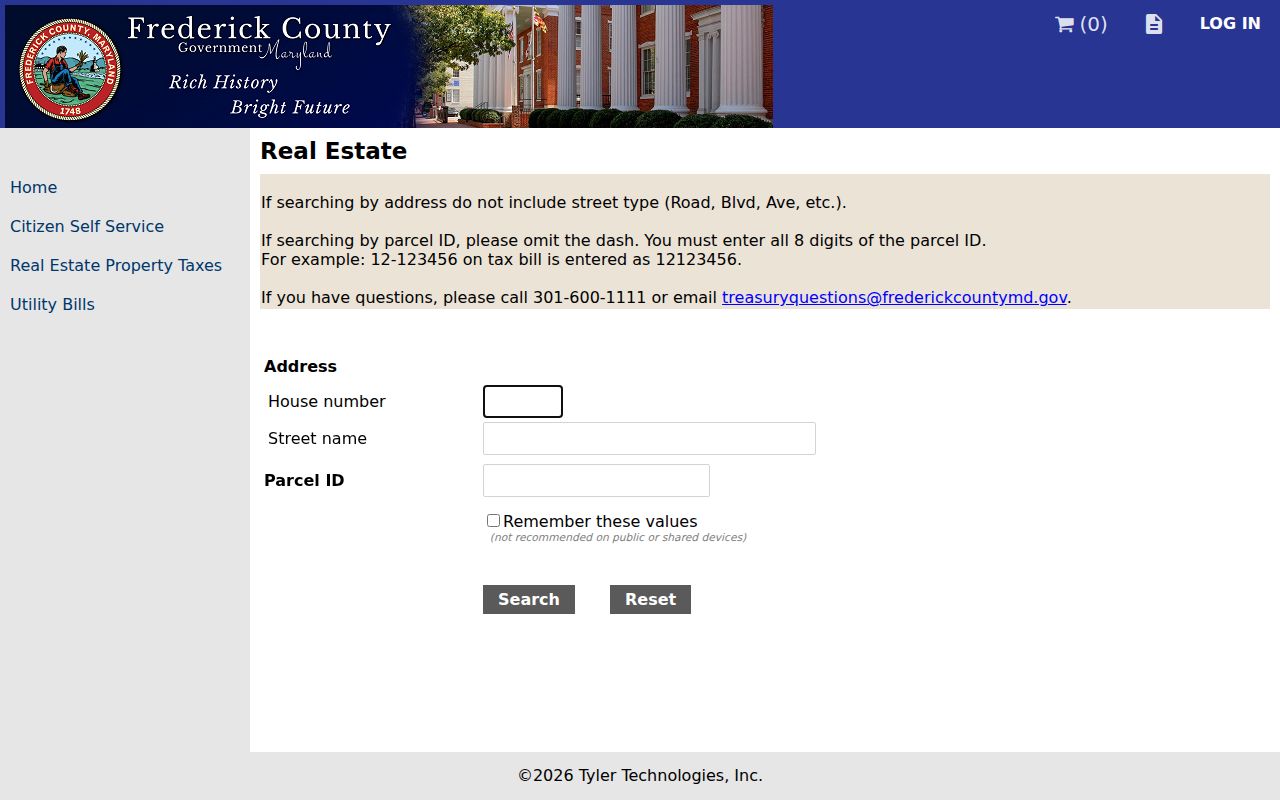
The official Frederick County Treasury entry page displays those exact search fields. Follow the format rules first, then contact the office if the lookup stalls.
| House number | Use with the street name for an address lookup. |
|---|---|
| Street | Enter the name without the street type. |
| Parcel ID | Enter all eight digits with no dash. |
The online search depends on the browser. Phone or office contact is the practical fallback when it will not render. Payment options are described through the Treasury page.
Frederick County Treasury sits at 30 N Market Street in Frederick and answers at 301-600-1111. Published hours run Monday through Friday, 8 a.m. to 4 p.m. The county accepts real-estate payments online by credit card or electronic check, by mail, at the counter, and through the secure front-entrance drop box. Partial payments are accepted through the Friday before the annual tax-lien sale. Interest keeps accruing after October 1. Every channel works even when the web lookup does not.
Frederick County Uses a Three-Year Assessment Cycle
Maryland real property runs on a three-year assessment cycle. That is why SDAT distinguishes base, current, and phase-in values. Put the assessment year and search date beside every figure. A permit, new construction, split, or other account change can add its own timing wrinkle.
The SDAT field glossary helps separate land, improvement, total, sale, and exemption fields. A transfer price may cover several parcels. Or it may reflect terms that make it a weak one-to-one comparison with assessed value.
Frederick Tax Rates Depend on Place and Year
The county tax-rate schedule publishes current and historical county, municipal, and special rates. A parcel in Frederick city, Brunswick, or Thurmont can carry a local layer. A county-only comparison misses it. Confirm the municipality from parcel and plat records instead of the postal city. ZIP geography proves nothing about incorporation. Annexation can reroute local taxes without changing who keeps the county land records.
Note: Put the tax year beside every rate because a correct rate from the wrong year still produces the wrong comparison.
Look Up a Frederick County Tax Bill Carefully
Begin with Treasury for the bill. Then turn to SDAT to explain the account behind it. Save the exact parcel ID and dates so a later payment or appeal check can be repeated.
- Search Treasury by address or the dash-free eight-digit parcel ID.
- Read the bill year, charge, payment status, interest, and any delinquency shown.
- Match the PAN and assessment fields in SDAT.
- Check the dated tax-rate schedule and any program status.
- Use the tax-sale and lien-certificate sources for transfer-level due diligence.
- Assessed value
- The official value used in tax administration.
- Tax rate
- The dated rate applied by a taxing jurisdiction.
- Homestead Tax Credit
- Maryland relief that limits qualifying assessment growth.
- Tax lien
- A legal claim tied to unpaid tax, not an automatic ownership transfer.
Frederick Lien Certificates Exclude Municipal Charges
The county lien-certificate request uses SDAT IDs and covers one parcel. The certificate costs $20 plus a convenience fee. It asks for three business days. When a child parcel has no bill, use the parent parcel as directed.
Municipal charges are excluded. A transfer involving city or town utilities needs a separate local check. The county deed checklist also requires a water and sewer transfer request or final bill.
A Frederick Tax-Sale Listing Is Not a Deed
The Frederick County tax-sale page posts the current schedule, registration, auction, redemption, and historical results. A parcel may be delinquent. It may be advertised, sold as a certificate, redeemed, in court, or later conveyed. Those are distinct states. Never label a listed parcel as foreclosed. Do not assign a new owner from the auction list alone. When legal status matters, pair Treasury status with Maryland Case Search and the recorded land records.
Under current county procedure, taxes are due July 1 and annual delinquency begins October 1. Principal-residence semiannual installments use September 30 and December 31 dates in the current materials. The county generally holds an internet auction on the second Monday in May. The published 2026 date is May 11. Registration details and deadlines shift with each sale. Rely on the page for the applicable year rather than carrying old dates forward.
A certificate remains subject to redemption and is not automatic title. Current procedures set different timing for later legal action depending on owner-occupied status. Older county material gives different timing. That is a reason to follow the current procedure and the court docket instead of blending old and new instructions.
Frederick Homestead and Credit Records Use State Routes
The Homestead Tax Credit runs through Maryland SDAT. The department handles the application and status route and publishes appeal guidance for denials. Separate credit programs exist. Each carries its own eligibility rules and its own application records.
A credit shifts the tax outcome. It does not rewrite the parcel's deed or its market history. When you compare Frederick County tax records across years, keep the application year, account, notice, and determination side by side. The numbers stay honest.
Appeal a Frederick County Assessment on Time
An assessment appeal in Maryland starts with SDAT. An owner has 45 days to challenge a new assessment notice. From there, the route can run through a petition for review. It can also reach the later appeal levels the state describes. A strong case leans on comparable sales, property-condition facts, and a clean account record. A bare claim that the bill feels high is not enough.
The online assessment appeal form asks for county, notice, and control information. Copy the notice date. That date controls the filing window.
Gather your materials before filing. Copy the SDAT assessment year and its value components. Collect dated photographs or other condition evidence. Pick truly comparable sales instead of tax bills from nearby parcels. A clerical parcel mismatch is not a value disagreement. If that is the dispute, say so plainly and separately. The state appeal guidance walks through the initial appeal and the petition for review. It also covers the Property Tax Assessment Appeals Board and the Maryland Tax Court. Check each stage against the current notice before you file.
Appeal window. File within 45 days of the Maryland assessment notice. Check the notice and current SDAT instructions before submitting the county, control, and evidence fields.