
Read the Main Frederick County Deed Types
A recorded deed proves a transfer happened and shows its terms. The type label matters. It hints at the transferor's capacity and the promises made, but the name alone never proves that no other interest exists.
| Deed Type | What It Does | Common Use |
|---|---|---|
| General warranty | Conveys the stated estate with broad title covenants. | An ordinary sale with broad assurances. |
| Special warranty | Limits covenants to claims through the grantor. | A transfer with a narrower warranty period. |
| Quitclaim | Conveys whatever interest the grantor has, if any. | Correcting or consolidating an interest. |
| Trustee or personal representative | Conveys in a stated fiduciary capacity. | Trust, estate, or court-connected transfers. |
| Tax-sale related instrument | Documents a later statutory tax-sale stage. | Research paired with redemption and court status. |
A mortgage or deed of trust secures debt; a release records satisfaction. A lien asserts a claim. A plat depicts a subdivision or survey. Only the instrument's own text explains what it did to the land.
Read related instruments as a dated set. One deed may reserve an easement. It may cite covenants, or convey just a single parcel in a larger deal. A later release can satisfy one deed of trust while another lien still stands. Case Search and the Maryland Judiciary judgment search can point toward foreclosure, partition, quiet-title, or boundary litigation. The full court file stays with the clerk. That summary is never the final land instrument.
Start Frederick Deed Records with SDAT Liber and Folio
The SDAT Real Property Search is the fastest bridge from an address to a deed. Select Frederick County and find the parcel. Copy the Deed 1 or Deed 2 liber and folio exactly, then save the owner line, sale date, PAN, and short legal description.
Copy that reference into MdLandRec. If SDAT offers no useful prior reference, search the recorded index by party and date instead. An assessment record orients you. It is no replacement for the recorded image.
Search Frederick Parties, Companies, Trusts, and Estates
MdLandRec searches individuals and corporations alike. Name matching includes starts with, ends with, contains, fuzzy, and Soundex options. The controls go further. Date, legal-capacity, related book/page, marked-list, and Jump fields narrow results when the owner is an LLC, trustee, estate, or a name recorded in another form.
| Name | Individual or corporation with variant matching. |
|---|---|
| Date range | Narrows a period without assuming the recording day. |
| Legal capacity | Distinguishes a trustee, representative, or other role. |
| Book and page | Moves to a cited liber/folio. |
| Jump | Follows a known reference. |
Search both sides when spelling or capacity is doubtful. Confirm the operative language on the image itself.
Trust and corporation searches work best with spelling taken from the deed rather than an abbreviated assessment line. Search a personal representative in the capacity shown. Test a former name too. The marked-list function holds plausible results while you compare property descriptions. That habit is safer than grabbing the first matching surname in a county with a long recorded history.
Frederick's Deed Books Reach Back to 1748
Frederick's surviving land-record series reach back to 1748. Maryland State Archives guides point to court land records, mortgages, plats, assessments, and historical index leads. These include CE109 and T165. The oldest trail may require books or microfilm. A modern search alone will not reach it.
Retain every liber and folio, spelling, clerk notation, tract name, and adjoining owner. Those clues link an old index entry to the right book. Street addresses were simply not parcel keys then. The historical index is also where local place names become research keys. A tract, addition, subdivision, former road name, or adjoining owner can connect records. This works even with no modern situs address. Once an older deed surfaces, compare its acreage and calls with the later instrument. Do not assume a shared name proves the same land.
Frederick's deep record horizon rewards a documented chain. It also multiplies the chances of similarly named people and divided parent tracts.
Note: Historic maps add context, but a deed, plat, or court order carries greater weight for title and boundary questions.
Walk Frederick County's Grantor-Grantee Index Backward
Walk the grantor-grantee index backward. Each seller becomes the next search subject. Begin with the newest known deed, then use its prior reference and party roles to find how that grantor acquired the land.
- Open the current acquisition deed and identify grantee and grantor.
- Read the legal description and its "being the same as" or prior liber/folio clause.
- Jump to that reference, or search the grantor as an earlier grantee.
- Check that acreage, lot, plat, and exceptions still describe the same land.
- Use historical indexes, books, microfilm, or Archives help when online access ends.
- Grantor
- The party conveying the interest.
- Grantee
- The party receiving it.
- Chain of title
- The connected sequence affecting the same estate.
- Liber/folio
- Maryland's book-and-page reference.
Pair Frederick Deeds with Recorded Plats
SDAT descriptions can be brief. The deed may point to a recorded plat, which supplies roads, easements, outlots, and dedication details. Search the Maryland plat portal by county or plat.
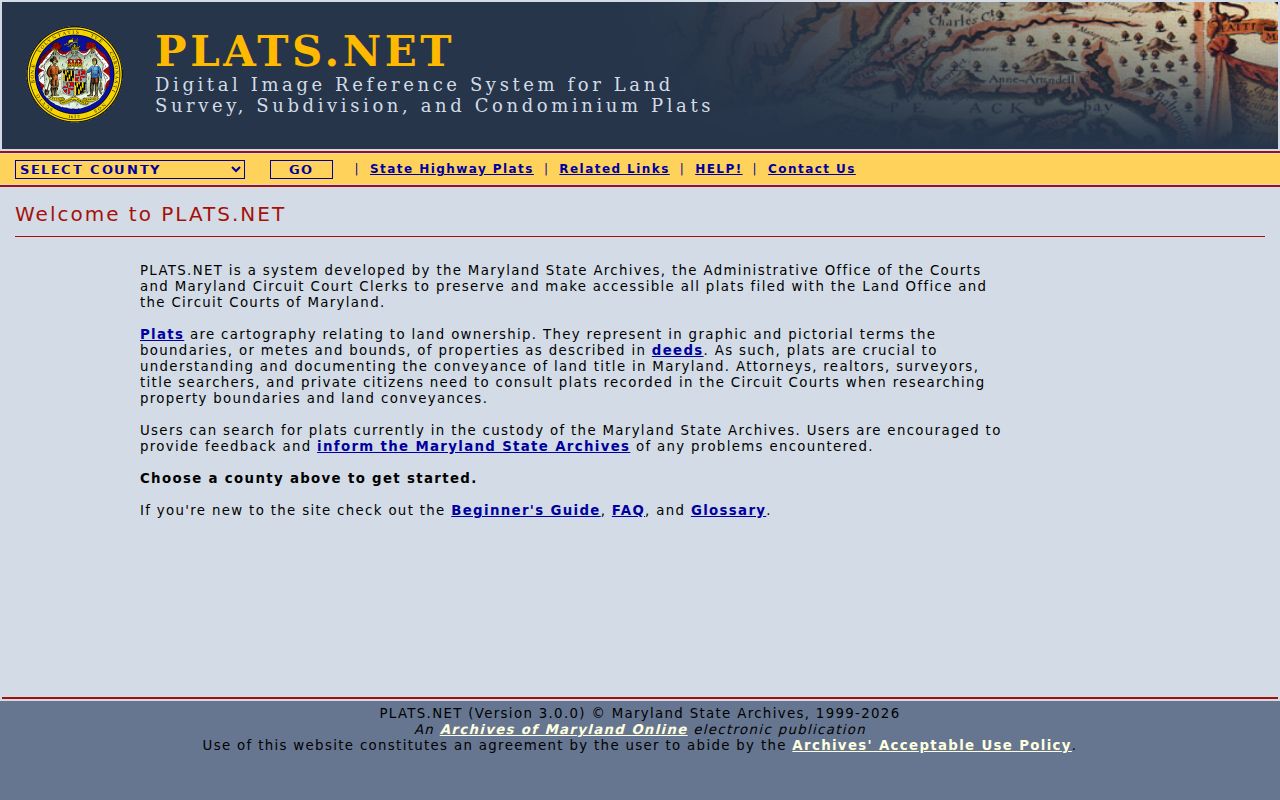
Unindexed plats may need Archives or Clerk help. A recorded plat is a land instrument; the County GIS polygon is a separate reference layer.
A Frederick Transfer Requires More Than a Signed Deed
A signed deed is not enough. The county's Record a Deed checklist calls for a lien certificate, water and sewer transfer request or final bill, Maryland Land Instrument Intake Sheet, and the original deed with copies. Frederick City review applies in election district 02.
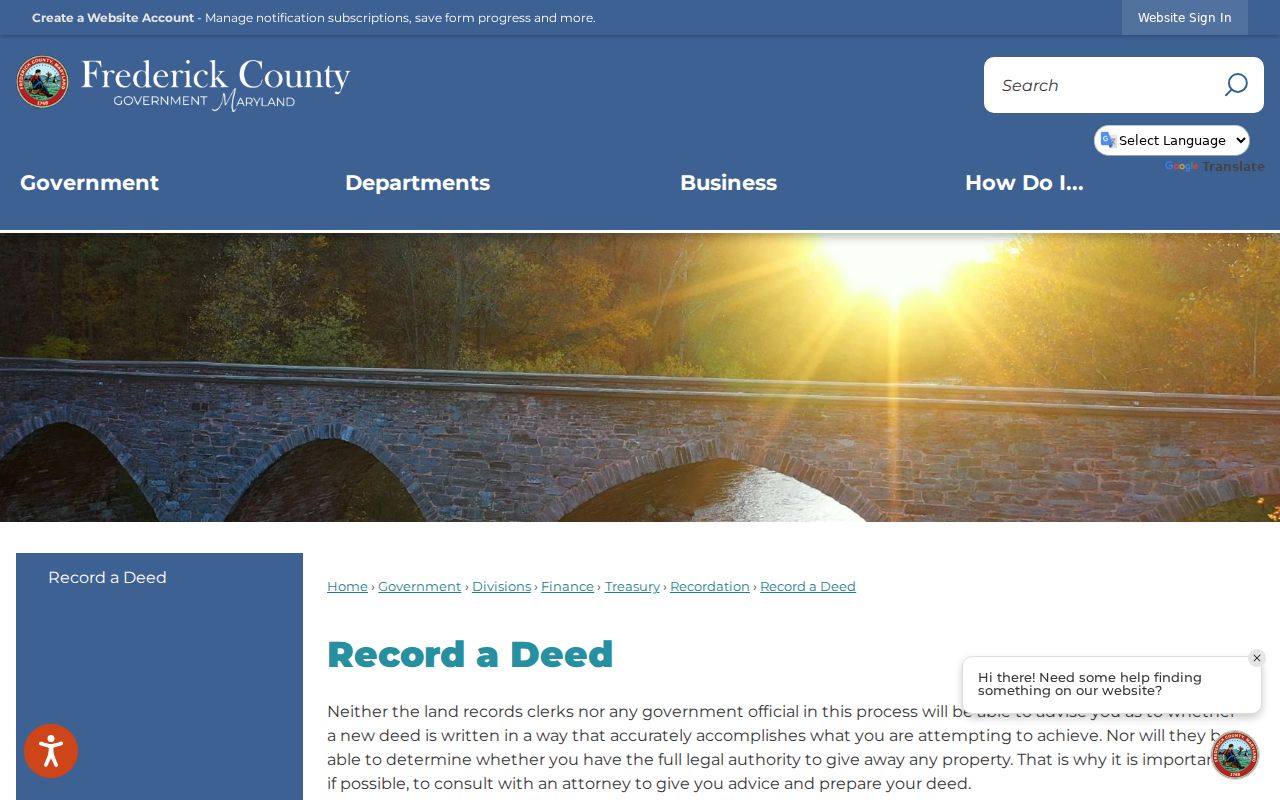
The lien certificate covers one parcel. It costs $20 plus a convenience fee, excludes municipal charges, and per the current page allows three business days. That gap helps explain why closing and recording dates differ.
Use the Frederick Courthouse When the Web Stops
The Clerk of the Circuit Court keeps Land Records at 100 W Patrick Street, Frederick. Land recording is 301-600-1965 and the records room is 301-600-1957. This is the fallback for access and copy questions that remote images do not resolve.
Check current Clerk fee information at request time because charges can change. Staff do not perform a title search for the requester.
Obtain a Frederick County Deed Image or Certified Copy
Frederick County deed images travel two routes. MdLandRec covers remote viewing of available records. The courthouse records room handles in-person requests, while the Clerk handles formal certified copies. Volumes from earlier eras may sit with the Maryland State Archives instead. Wherever you order, include the county, the parties' names, the document type, and the date. Add the liber/folio if you have it.
Decide between a plain image and a certified copy. A plain image works fine for most research. A certified copy carries the Clerk's authentication. Confirm with the receiving office which form it actually requires before you pay for anything.
For mail or counter requests, name Frederick County, list both parties when known, and give the document type. Include the recording date and liber/folio. If your reference falls in an older series, ask whether the courthouse or the Maryland State Archives holds the accessible copy. The Clerk's current recording-fee schedule governs filing charges and transfer taxes. Copy charges should be confirmed for your specific request. Relying on a fee quoted from an outdated saved page is a mistake.
Recorded, not guaranteed. Frederick County deed records show filed instruments. An index hit or image is not a title opinion and does not rule out an unrecorded interest.